 TR
TR EN
EN DE
DEShowing 17–32 of 50 results
BASIC SCIENCES
- TB_17
Graphics Race
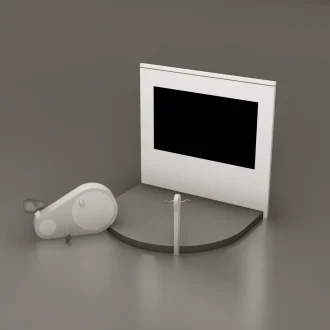
TB_17It is a fun setup consisting of a hand pedal and a bicycle, coordinated in pairs to reach the graphic curve of a mathematical expression on the screen and create the shape closest to that line.
TB_17 - TB_18
Hanoi Towers
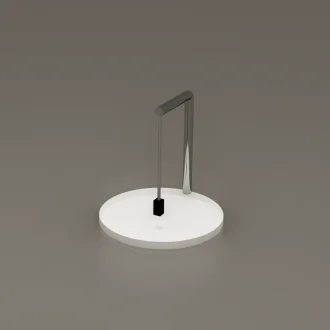
TB_18Towers of Hanoi is a
math and intelligence game that requires 7 disks to be placed on a board
with 3 vertical bars in accordance with the rules. During transportation; the disks should be arranged from big to
small, only one disk should be moved
in each move, and the big disk
should not be placed on the small disk in any move. When moving the disks in Hanoi towers
the disks should be moved with minimum moves.TB_18 - TB_04
Impellers and Gears
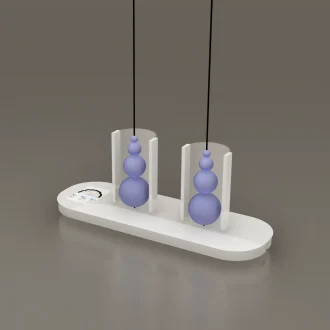
TB_04Wheels and gears are simple machines. Wheels and gears can be used adjacent to each other, or they can be used with belts or chains when the distance between them increases. The gears attached to each other rotate in opposite directions. When two different sized wheels are connected to each other, the number of rotations of the small wheel is more and the number of rotations of the large wheel is less.
TB_04 - TB_50
Life Zones
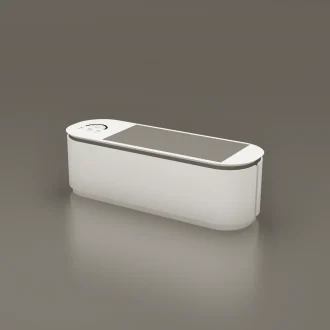
TB_50There is an area on the table with models of the four basic components of the ecosystem. As the visitor moves the sliding screen, the features of the component group to which the object in the model in front of him/her belongs are shown on the screen. The ecosystem components to be included are non-living entities, producers, consumers and decomposers.
TB_50 - TB_24
Magnetic Pendulum
TB_24In this system, there are
magnets in the table at the bottom of the pendulum. The pendulum makes various mixed oscillations
in the direction of the magnetic field
created by the magnets, different from the simple pendulum. At the end of the oscillation, the pendulum is fixed
close to a certain magnet.TB_24 - TB_25
Momentum
TB_25The visitor is presented with a series of bouncing balls neatly aligned on top of each other with a guide wire. Visitors release the balls and as they fall downwards, the kinetic force of each ball is transferred to the ball above it as it hits the ground. The mass of the balls decreases as you move upwards, the speed of the balls must increase to maintain linear momentum. As a result, the top ball on the wire flies upwards.
TB_25 - TB_27
Mosaic
TB_27Visitors learn about the motifs by examining the graphic and start the game from the touch screen on the table. The visitor tries to create the graphic on the screen by selecting the squares in the one-color grid system.
TB_27 - TB_28
Newton Balls
TB_28When the first ball is pulled and released, it gains a velocity, and the physical quantity
resulting from the product of this velocity and the mass of the ball is called momentum. Since the balls are of equal mass
, as soon as the first ball hits the ball next to it, it transfers its momentum to the other ball based on the principle of conservation of momentum
. In this way, the transfer
is completed and the next ball has the same momentum as the last ball. Since the masses and
momentum are the same, the last ball will move with the speed
of the first ball.eTB_28 - TB_30
Optical Table
TB_30With the Optical Table exhibition unit,
optical laws are examined by using laser beams, lenses and mirrors in 1, 3 and 5 beams
. The reflection and refraction of light,
mirror and lens experiments, and experiments reflecting the properties of prisms
allow us to obtain detailed
information about optics. In addition, with the necessary
measuring devices, the focal length and
angles of the rays with the surface normals
are calculated.TB_30 - TB_31
Palanga System
TB_31A pulley is a type of simple machine that gains in strength and loses in distance. In this setup, 3 weights of equal mass are attached to a system of 3 pulleys with different numbers of pulleys. You can examine how the force required to lift the same mass varies with the number of pulleys.Suitable for outdoor use.
TB_31 - TB_09
Pattern Table
TB_09It consists of 50 different geometric shapes in different colors (triangle, square, polygon, trapezoid, parallel-sided quadrilateral), as well as a table where children can sit with their families and experience pattern combination freely. There are 4 stools around the pentagonal table where visitors can sit with their families. There is a pattern on the panel where they can see the pattern.
TB_09 - TB_33
Periodic Table
TB_33With the help of the touch screen, the device provides information about all
elements in the periodic table. At the same time, the visitor creates different molecules by using different
elements and
can have information about which elements
some of the substances around us are composed of. There is a question section
where visitors can test themselvesTB_33 - TB_35
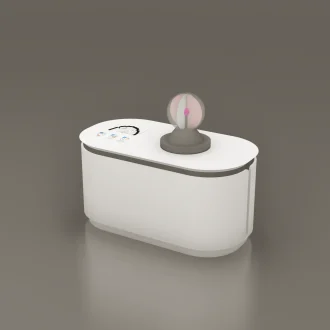
Plasma Sphere
TB_35At the appropriate high electric potential difference (voltage) and pressure, the gases ionize and conduct electricity just like a conductor and arcs are formed. When you touch the sphere, you affect the electric field of the plasma ball and attract electric arcs to yourself, just like a lightning rod. There are models with plasma balls of different diameters and numbers.
TB_35 - TB_06
Polyhedra
TB_06On the panel, there are expansions of cube, triangular prism, rectangular prism, square prism. The visitor obtains cube, triangular prism, rectangular prism, square prism by folding the prisms whose expansions are given.
TB_06 - TB_36
PRAXINOSCOPE
TB_36This setup consists of segmented mirrors and a picture tape. The picture tape is placed on a circular background. The segmented mirror
group is placed in the center of this floor. The number of
pictures on the picture tape and the number of mirrors in the segmented mirror group are the same.
When the set-up is rotated, the rapid passage of the reflected images creates the illusion of a moving
image. This system is the
basic principle of cinema.TB_36 - TB_29
Probability Parabola
TB_29The setup consists of a large number of balls, paths along which the balls can move and a ball house. The system is moved back and forth so that the balls fall down from the top and the distribution of the balls is observed according to the probability principle. It is a device that is suitable for science centers in the examination of the principle of probability and teaches while entertaining.
TB_29